Measured on August 20 and 21, 2026, across 97 snapshots. ESX dominates, with 6.5 times the connected players of QBCore. And the world’s second place does not belong to QBCore, it belongs to vRP.
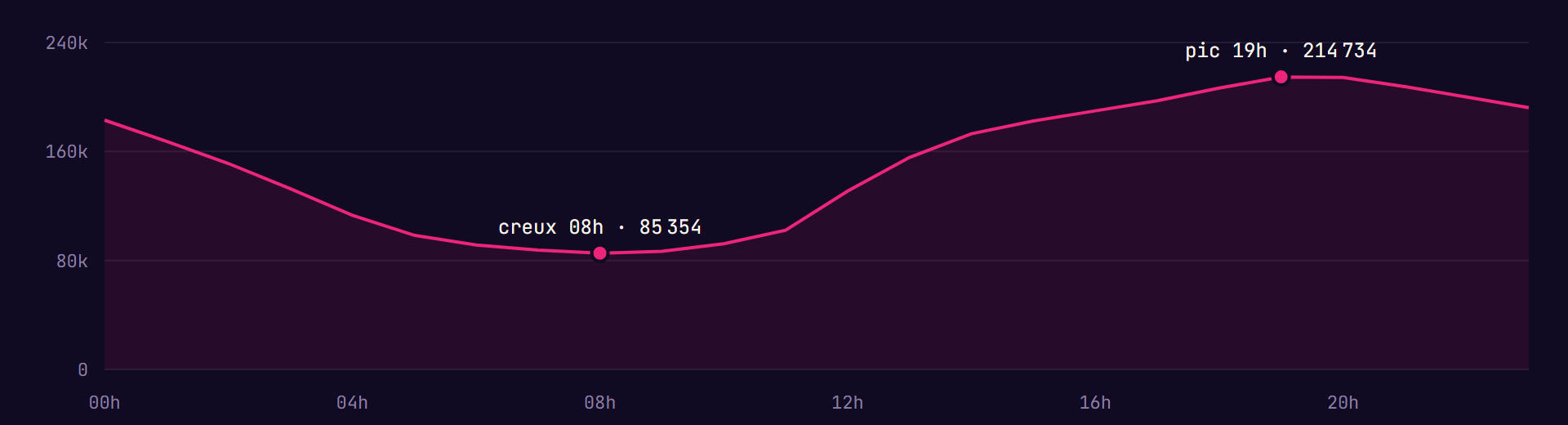
These numbers do not come from a poll or a gut feeling. The public FiveM server list, the one your launcher queries, is open to everyone: around 35,000 servers continuously declare their player count, their language and their tags. Our team sampled it 97 times over 24 hours, from August 20 at 16:25 to August 21 at 16:12 UTC, which adds up to 3.33 million observations. As a side effect, that answers a question many people ask: FiveM is roughly 35,000 listed servers, and up to 214,734 players connected at the same time during the evening peak. Every number in this article is an average over those 97 snapshots, never a single reading.
One bit of vocabulary before the numbers, because nobody else clears it up: an “ESX server” in this measurement is a server that declares the esx tag in its configuration. That is declarative, just like the player counter. A server can lie, be misconfigured, or declare nothing at all. It is the limit of every measurement of this ecosystem, ours included, and we would rather state it upfront than bury it in a footnote.
ESX or QBCore: which one has more players in 2026?
ESX, and it is not close: 54,734 players connected on average across our 97 snapshots, against 8,385 for QBCore. Six and a half times more. In listed servers the gap is tighter, 12,178 against 4,669, which tells you something rankings never show: ESX servers are bigger on average. The framework of the large communities on one side, the framework of servers that are just starting out on the other.
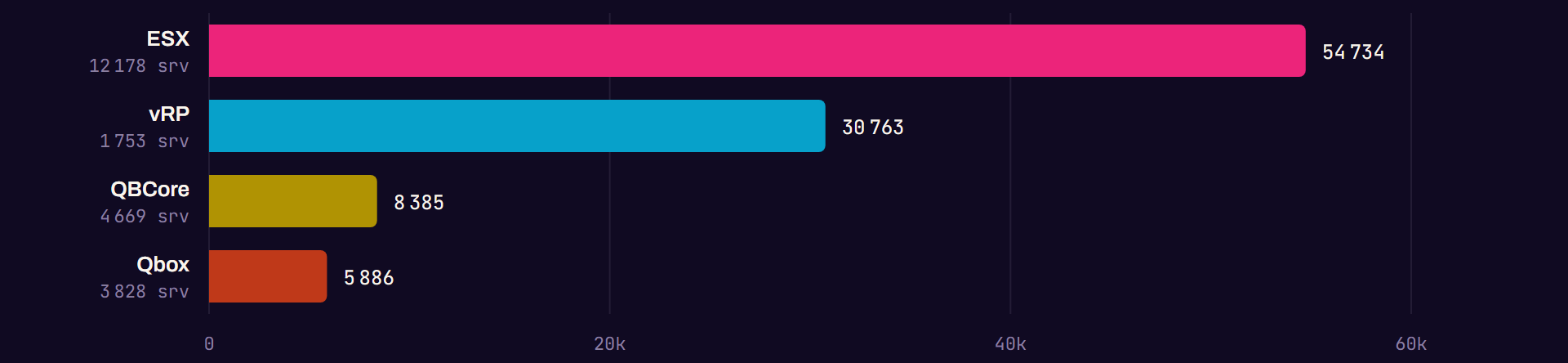
The most used FiveM framework in 2026 is therefore still ESX, in players and in servers alike. And second place is not who you think: vRP carries 30,763 players on average, almost four times QBCore, on only 1,753 servers. We come back to it below, because that number alone disqualifies most published comparisons.
Why are the rankings you read everywhere wrong?
Because they count servers instead of counting players, and they measure at a single hour: both biases push the same way, and they are huge.
First bias: most listings are empty. Across our snapshots, only 22.8% of English-speaking servers had at least one player connected, 19.3% of French ones, 15.7% of German ones. A ranking by “number of servers” therefore mostly counts empty shells, and it mechanically inflates the frameworks that are easy to install, the ones people spin up one evening and abandon.
Second bias: the hour. The ecosystem carries 85,354 players at the 08:00 UTC low and 214,734 at the 19:00 peak. A factor of 2.5 between the two. Any statistic taken from a single snapshot depends first on what time it was taken, and on which continent it favors.
Is ESX dead?
No, and the facts carry dates: three releases since May 2026, and detection of the game’s Enhanced edition merged in twelve days. The question comes back every year since 2021, so here is what the public repository shows. ESX Legacy shipped 1.13.5 on May 25, 2026, 1.14.0 on July 17, and 1.14.1 on August 16. And when GTA V’s Enhanced edition needed detecting, the pull request was opened on July 23 and merged on August 4: twelve days. A dead framework does not answer in twelve days. Add the 54,734 players measured above, and the question is settled for 2026.

Is QBCore dead?
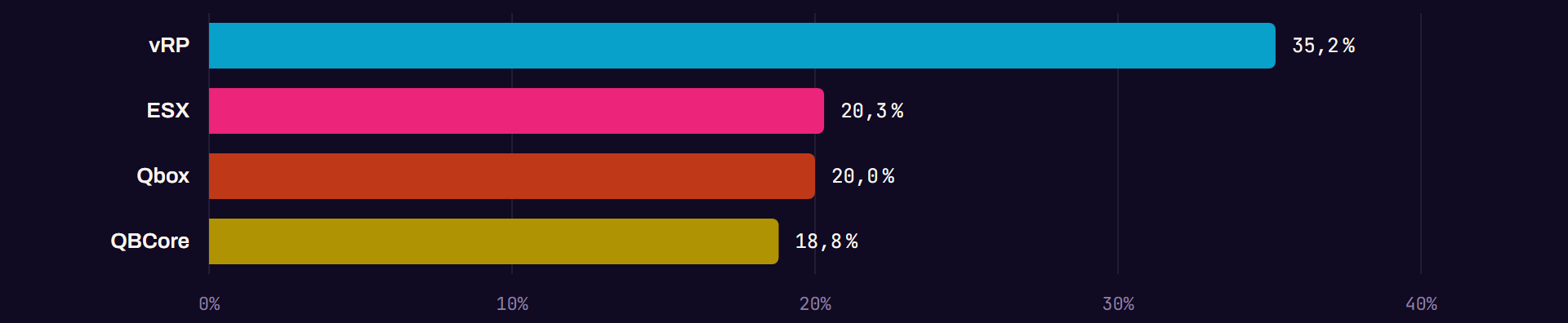
No, but it is declining, and the word goes around for real reasons: first place nowhere in players, the emptiest listings of the four frameworks, and an ecosystem that is starting to drop it. In our measurement, QBCore carries 8,385 players, four times less than vRP, and only 18.8% of its listings had at least one player, the lowest rate of the four frameworks.
The hardest signal does not come from a forum, it comes from code. On August 5, 2024, ox_inventory, the inventory of the ox stack, deleted its QBCore bridge: 761 lines removed in one go, with a commit message that pulls no punches: “Removes the cancer that is qbcore.” Qbox support, on the other hand, never moved.
Community mood follows. Asked “QBCore or Qbox?” on Reddit in June 2024, one user answers: “Qbox, Qbcore is dead.” One comment is not a statistic, but it tells you which way the conversation leans, and our numbers say the same thing more politely.
Is Qbox already replacing QBCore?
In server count, the shift is underway: 3,828 servers declare Qbox against 4,669 for QBCore, already 45% of the QB ecosystem. In players, QBCore keeps the lead, 8,385 against 5,886: the large QB communities have not migrated, it is the recent servers that pick the fork. If the trend holds across our next measurements, the question “ESX or QBCore” will need rewording into “ESX or Qbox” faster than most guides think.
Qbox was born in September 2022 as a QBCore fork, and its documentation sets the tone: backwards-compatibility for “almost all QBCore scripts, with a few exceptions”. That compatibility is what makes the switch nearly free for a server, and what explains the adoption curve among new servers.
We see it from our seller’s window too: install requests for Qbox have become routine among our buyers. And from our vantage point as developers who maintain both targets, the two frameworks work almost identically: our scripts run on Qbox just as they do on QBCore, and the few differences are handled in configuration. That is what makes the switch cheap for a new server, and it matches what Qbox’s own documentation promises. As for the extra performance the fork claims, we measured nothing: this article weighs adoption, not speed.
And vRP, why does nobody in Europe talk about it?
Because vRP is a concentrated phenomenon: 78.7% of Portuguese-speaking players run on it, and Brazil alone is enough to make it the world’s second framework. 30,763 players on average, a peak of 54,952 players for the Portuguese language alone, on servers twice as big as the ecosystem’s average. English-speaking comparisons ignore it because they never cross its path: it is a geographic blind spot, not a reality of the field.
Two details say everything about that scene. Its servers are the most alive of the whole ecosystem: 35.2% of vRP listings had at least one player during our snapshots, nearly double QBCore. And yet the canonical vRP repository has not received a commit since May 15, 2025: the framework actually running those servers is not the one in the repository, it is private derived bases, rewritten by the big Brazilian teams.
Here is the breakdown by language, measured over the same 24 hours, two weekdays. One method note first: depending on the language, between half and four fifths of players play on servers that declare their framework, and the shares below are among those identified servers. In German, ESX crushes everything: 97% of players. In French, 91%. In Spanish, 73%. In English, 59%, with Qbox already at 18%. On the Portuguese side, vRP reigns at 94%. And Arabic is the only genuinely contested market: ESX 48%, vRP 37%.
That last number is a method lesson on its own. Our own single snapshot of August 15 put vRP first among Arabic-speaking players; twenty-four hours of measurement put ESX back in front. A single snapshot gets it wrong, ours included, and we would rather show that than hide it. A full comparison will follow after the stable release of FiveM Enhanced.
Which framework should you pick to open a server in 2026?
To discover server development: QBCore or Qbox. To grow: a base you own. That is our team’s recommendation, having opened several servers and grown them, and it comes in two stages.
At the start, QBCore or Qbox are good entry points because they come with a solid army of scripts. In their base state, after some configuration, they can already welcome players, and that is exactly what you need when you open: satisfy the first arrivals without months of development.
When the server grows, the framework as shipped is no longer enough. You then need solid foundations, and two roads lead there: take QBCore or Qbox apart and improve them in depth, or take the time to write a custom framework, cut for what your players expect. We walked that road ourselves: our servers opened on QBCore, and that framework ended up entirely rewritten in-house.
One question remains that does not depend on you: the market. The dominant framework changes with your server’s language, and it decides where you will recruit your devs and find your scripts. For that, the numbers above are the reference.
Should you migrate frameworks in 2026?
Not if your server runs and your team masters its base: a migration costs weeks and brings in no players by itself. The question deserves a cold answer, with numbers, not the fear of missing the train. Three cases stand out. From QBCore to Qbox, the step is low: backwards-compatibility carries most scripts across, and that is exactly why this path is the only one our measurement actually sees being taken. Between the ESX and QB worlds, the step is a wall: neither conventions nor scripts are shared, and you do not cross it for a ranking. And if your server grows to the point of hitting its framework’s ceiling, reread our own path above: the real migration is sometimes not toward another framework on the market, but toward a base of your own.
Our observations, from our production servers and seven bridge targets
This blog has one rule: half of an article must be things we lived, not read. Here is what we hold first-hand.
What QBCore cost us in production
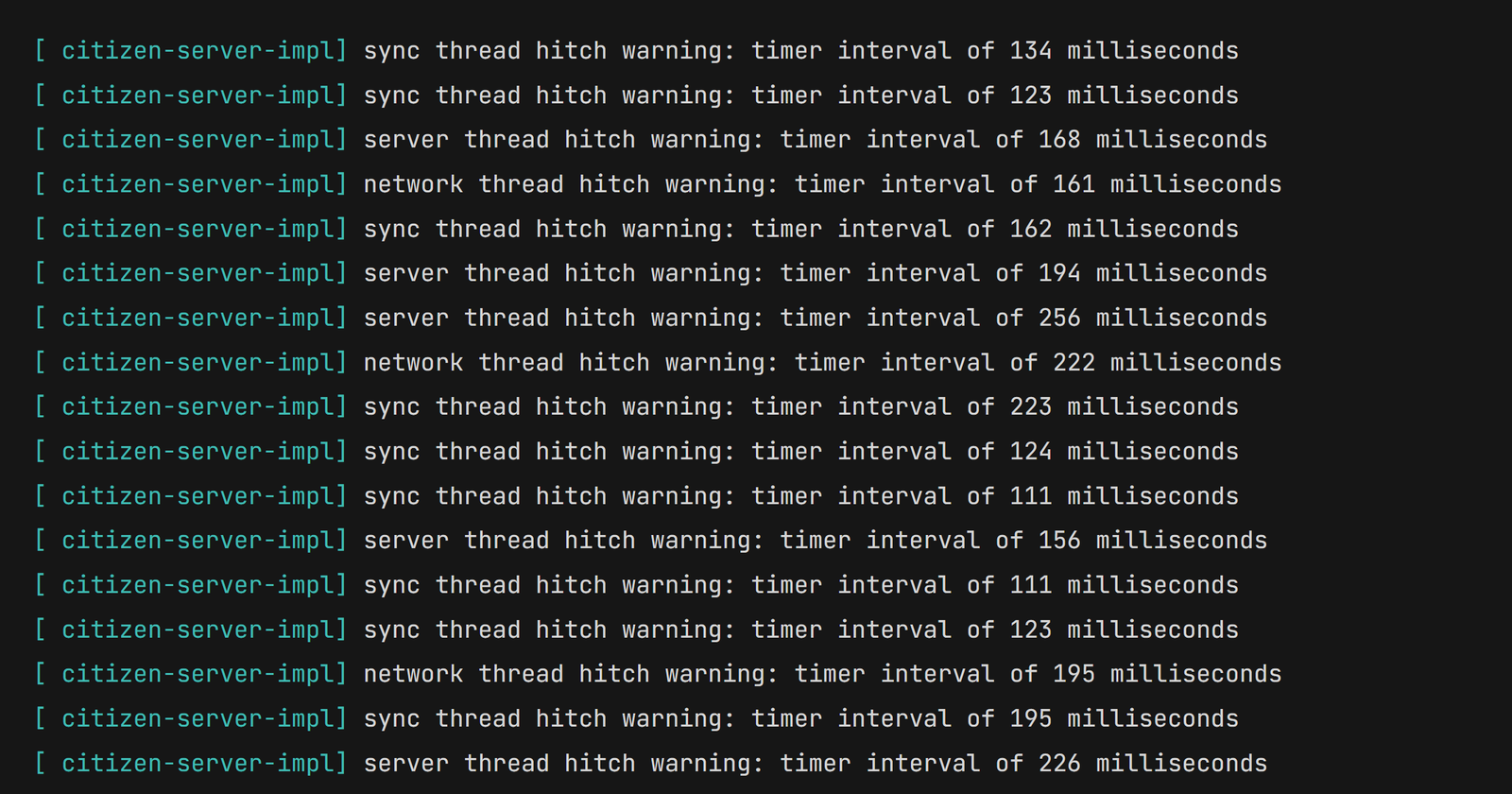
Our time on QBCore was a school, and tuition was paid in production. The more players climbed, the more we had to patch the base framework itself: looping calls, blocking SQL queries, server and network threads to rework. A QBCore server left in stock condition starts running out of breath around 300 to 350 concurrent players: that is the limit we saw with our own eyes, and it is what finally made up our minds. We first built up experience rewriting QBCore piece by piece, then we wrote an in-house framework.
What seven bridge targets teach you about frameworks
The scripts in our catalogue detect and plug into ESX, QBCore, Qbox, ox_core and vRP, plus a standalone mode and a custom mode. Writing and maintaining those bridges is the best comparative anatomy course there is: you see what each framework exposes cleanly, and what you have to work around.
The most striking lesson came from vRP. To enter FiveM, our team had learned the frameworks that exist on the market, and this one surprised us: it does not work like the European frameworks such as QBCore, neither in its conventions nor in how it exposes things. Yet it is the world’s second framework in players, with the highest players-per-server ratio of the whole ecosystem. Two possible explanations, and we have nothing to settle it: either the framework structurally takes bigger loads, or the big Brazilian servers rewrote it in depth over the years, the way we did with QBCore. The vRP scene lives on private derived bases, with no public repository to examine, so our research cannot confirm either one, and we would rather write that than pick the version that suits us.
What our support desk sees
On the breakdown of our buyers by framework, the honest answer is that we do not know it, and the reason is structural: our scripts detect the framework at startup, the same purchase serves ESX, QBCore, Qbox or vRP, so the sale never records what the script will end up running on. One signal exists though, imperfect but real: the information and assistance requests that reach us most often concern ESX. That is not a statistic, it is our support queue, and it leans the same way as the measurement.
The checklist before choosing
- The most played framework in the world in 2026? ESX, 6.5 times QBCore
- The second? vRP, carried by Brazil
- Is a ranking by server count reliable? No, 62 to 84% of listings are empty
- Does the hour of measurement change the result? Yes, by a factor of 2.5
- Is Qbox replacing QBCore? Among new servers, it is underway
- Is the player counter verified by Cfx? No, it is self-declared
- Is ESX dead? No: three releases since May 2026
- Is QBCore dead? No, but it is declining: 18.8% of listings alive
Frequently asked questions
Where do these numbers come from?
From the public feed of the FiveM server list, the one the launcher queries, sampled 97 times between August 20 at 16:25 and August 21 at 16:12 UTC, one snapshot every 15 minutes and 3.33 million observations. Every value in the article is an average over the whole set of snapshots, and the rate of servers actually played on is published next to the raw counts.
Can a server inflate its player count?
Yes: the player counter and the framework tags are declared by the server itself, and the platform does not verify them. It is the limit of every measurement of this ecosystem, ours included. It is contained by crossing snapshots over 24 hours and by publishing the alive-listing rate, but it does not disappear.
Are Qbox and QBCore the same thing?
No. Qbox is a QBCore fork created in September 2022, developed separately since, and its documentation announces backwards-compatibility for almost all QBCore scripts, with a few exceptions. In practice the same script generally runs on both, but the two projects evolve on their own paths, and our measurement counts them separately.
Do the scripts sold here run on all these frameworks?
Yes: every script in the catalogue ships preconfigured for ESX, QBCore, Qbox, ox_core and vRP, plus a standalone mode without any framework and a custom mode, with automatic detection at startup. The Framework line of each product page is authoritative for a given script.
Will these numbers be updated?
Yes, at every notable shift of the ecosystem, rather than on a fixed schedule. The measurement is an internal tool that can be rerun at will, every update will be dated in the history at the bottom of the page, and the previous value will stay readable. An ecosystem number without a date is worth nothing, ours included.
The history of this page
- August 22, 2026. First publication, on the snapshots of August 20 and 21.
Sources
The public FiveM server list, whose feed was sampled 97 times by our internal measurement tool. The FiveM documentation for server tags. The public repositories of the four frameworks: ESX, QBCore, Qbox and vRP. The aggregated data of our 97 snapshots is kept and can be produced.
Not sure what these numbers mean for your server? Our Discord answers, with no sales rep behind it.