Last verified: 14 August 2026. Since the Cfx.re enforcement waves of 2025, buying the wrong resource no longer costs you the price of the script. It can cost you the server.
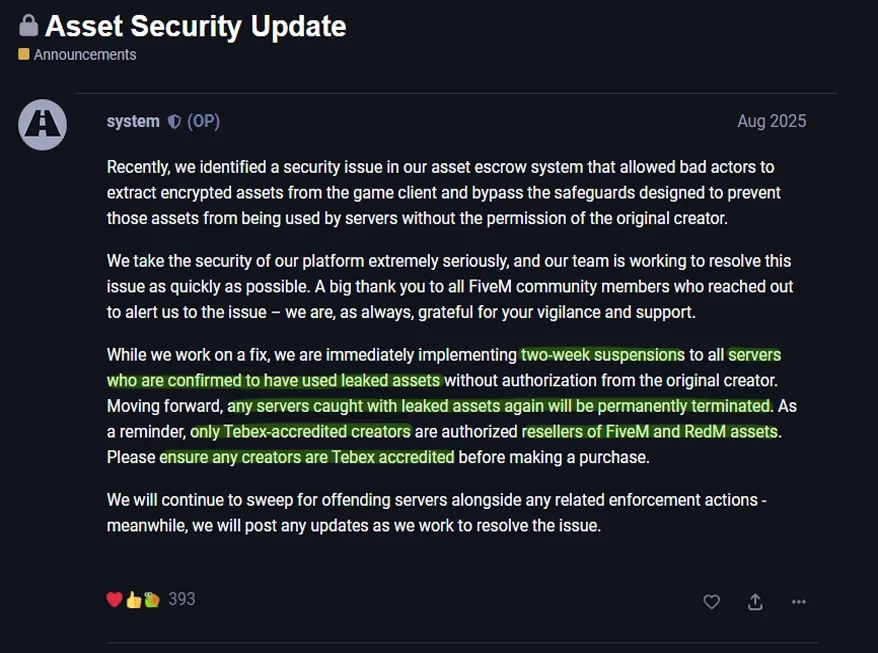
On 8 August 2025, Cfx.re announced “two-week suspensions to all servers who are confirmed to have used leaked assets without authorization”, adding that any server caught again would be permanently terminated. On 16 October 2025, the follow-up was blunt: the team had “suspended hundreds of accounts and servers associated with stolen assets, and permanently banned those confirmed to be in violation.”
That changes the question. Choosing a FiveM script used to be a budget decision. It is now a risk decision, and most of that risk is visible before you pay, provided you know where to look.
This page lists seven checks. Each one takes under five minutes, each one happens before the transaction, and each one ends with an exact question to ask the seller or an exact command to run. Nothing here asks you to take our word for it, and most of it can be used against us.
They apply to any paid resource, script, MLO, vehicle or clothing pack. We write “script” because that is the word the community uses, but escrow also encrypts models, and enforcement covers assets in general.
A point of vocabulary, because the three get confused constantly: an open source script lets you read and change all the code; an escrow script is encrypted by Cfx.re’s official system and exposes only what the seller chose to leave open; a leak is a copy redistributed without authorisation, whatever its technical state. The first two are commercial choices. The third is what gets a server banned.
Why “read the reviews” is not a method
Every buying guide in this space ends up at the same three pieces of advice: read the reviews, avoid obfuscated code, buy from a trusted seller. The first is gameable, the second is impossible on an escrow resource by design, and the third is circular. None of them is a check. A check has an input, a procedure, and a pass or fail.
1. Is the seller a Tebex-accredited creator?
Cfx.re states it plainly: only Tebex-accredited creators are authorized resellers of FiveM and RedM assets. This is not a quality label, it is an authorisation rule, and it decides whether you have any recourse at all.
Three things to verify, in order:
- The checkout runs through Tebex. Not a Discord transfer, not PayPal friends and family, not a crypto address.
- Delivery lands in your Cfx.re Portal, not as a
.zipin a private message. A resource that arrives as an archive did not come through the escrow system, whatever the seller says about it. - The seller has a release thread on forum.cfx.re with a dated history. A vendor active for several years leaves a public trail. With no trail, they have either just started or rebranded after a problem.
Outside that path there is no recourse to lose: there is none
This is the point most buyers understand too late, and it asks you to trust nobody. It follows from how the system works.
A purchase outside Tebex produces no Portal delivery, therefore no entitlement attached to your Cfx.re account. You do not have a badly bought resource: you have a folder of files, and nothing attesting that you are allowed to run it. There is no recourse to pursue because no record of the transaction exists on the platform side.
It takes many forms. Shops built outside Tebex. Listings on general freelancing marketplaces. And above all Discord servers dedicated to resale, often alongside cheats and other illegal tooling, where you pay first and hope afterwards.
We will not pretend to measure how often scams happen in that circuit, and we are wary of articles that assert it without demonstrating it. The reasoning is enough: in a transaction with no record, no platform and no verified identity, the only thing guaranteeing delivery is the seller’s goodwill. Do not rush because an offer expires in two hours. That is precisely the moment when nobody checks anything.
This first check carries the six that follow. On an escrow resource you cannot read the code, so everything you cannot verify yourself transfers onto the seller’s accountability. That is why it comes first and not last.
2. Is the asset legitimate, and what does your server risk?
This is the chapter buying guides skip, because it is uncomfortable for a seller to write.
“I did not know it was a leak” is not a recognised category. The 2025 enforcement targeted servers confirmed to be running unauthorised assets, and a decrypted resource is detectable server-side regardless of the buyer’s intent. Your good faith is not a technical property of the file.
Five signals that disqualify an offer before you even look at the code:
- A pack of thirty to forty premium scripts for under twenty euros. The arithmetic does not work. Legitimate bundles exist, but they bundle one studio’s own catalogue, not a cross-section of the market’s paid releases.
- Delivery by archive rather than through the Portal.
- A known premium script sold under a different brand name, often with the original config file untouched.
- No changelog at all. A maintained resource has a version history. A copied one has a download date.
- A seller who will not state the Cfx.re account the purchase will be attached to.
3. What will you still be able to change after paying?
On an escrow script the code is encrypted by Cfx.re’s official system. But the developer chooses what stays readable, with the escrow_ignore directive in fxmanifest.lua.
The consequence is the whole point, and almost nobody spells it out: what is left open is a decision made by the seller, not a property of escrow. Two escrow scripts at the same price can be worlds apart in how much you can adapt them. If a setting is not surfaced in an open config file, it is inaccessible for good, not by you, not by your developer.
Hence the question to ask before paying, the one that separates a serious vendor from a reseller:
What does your
escrow_ignorecontain?
Four things should be in it, and the fourth is the one nobody asks for:
- The configuration, otherwise no setting is adjustable.
- The translation files, otherwise you cannot adapt a single word to your world.
- The bridge files, otherwise you cannot wire it into your framework.
- The SQL install schema. It tells you which tables the resource will create in your database, and therefore what it will do there. Reading it before installing takes two minutes.
A vendor who cannot answer, or who answers evasively, has just told you something important.
We do not re-explain the escrow mechanism itself here. We keep a dated page on where Asset Escrow stands on FiveM Enhanced, which covers a different question, that of its availability.
4. Can you spot a backdoor before starting the resource?
This check only applies to code you can read: open source resources, and the files a vendor left outside escrow. On a fully encrypted resource it is worthless, and everything falls back to the first check. Any guide telling you to “inspect the code” of an escrow script is describing something you cannot do.
A backdoor does not necessarily break anything, and that is the problem
People picture a script that wipes the database or empties bank accounts. In practice, a backdoor that gets noticed has failed. The ones that last break nothing.
We have seen servers running compromised resources, and the rate is markedly higher on scripts that come from a leak than on resources bought from a creator with an official store. Two families come up.
Data extraction. The best known: the resource reads your database and sends back anything exploitable. Nothing fails, nothing alerts, and the server runs perfectly while its data leaves.
Events left open to enable cheating. This one is less known and more insidious. The resource ships exploitable events that let a cheat do undetectable things on your server. It is not always negligence: it is sometimes done together with cheat authors, whose tool then looks more powerful than the competition’s. What is being sold is not the script, it is the door.
The practical consequence is simple: a creator’s reputation is not a comfort detail. A few searches on their name, their history and their public threads is usually enough to know who you are dealing with.
Three patterns to look for in readable code
A server event that writes without checking who called it. Any client can trigger a registered net event. If the handler trusts its arguments, any player can pass it anything.
RegisterNetEvent('shop:giveItem', function(item, amount)
  MySQL.update('UPDATE users SET money = money + ?', { amount })
end)
The tell is the absence of source validation and the absence of any server-side check that the request is legitimate. It is also exactly the shape an event left open on purpose takes.
An HTTP call to a host that is not the vendor’s. Licence checks exist and are normal. A licence check to a domain unrelated to the seller, sending more than an identifier, is not.
A string decoded then executed at load time. A legitimate resource has no reason to build code at runtime from an encoded blob.
A quick sweep over your resources folder, before anything starts:
grep -rn "PerformHttpRequest|load(|assert(load|_G[" resources/The community also describes a recurring symptom worth knowing by name: code that reappears at the bottom of client.lua, config.lua or server.lua after being deleted. If that happens, the resource is not the thing to fix, it is the thing to remove.
5. What does the script actually cost in performance?
Product pages advertise 0.00 ms by the dozen. The figure is usually true and almost always meaningless, because it is measured at rest: resource loaded, nobody interacting, nothing happening. It is the equivalent of quoting fuel consumption with the engine off.
A resource has to be measured in three states:
| State | What you measure |
|---|---|
| At rest | The script is loaded, nobody is using it |
| In use | One player actively interacting with it |
| Peak | The realistic worst case, several players at once |
The reference points, using the community’s working conventions rather than any official standard: at 60 Hz the whole frame budget is 16.67 ms for everything running at once. A healthy resource sits between 0.00 and 0.05 ms at rest. Past 0.10 ms you look closer. Past 0.5 ms at rest, something is wrong, and that is before any player has touched it.
To measure it yourself: F8, then resmon 1.
What an honest reading looks like
Since we are asking for three states, here are ours on avenida_interact, with the test bed that goes with them. Without the protocol, a figure means nothing.
The bed: 100 fixed interaction points, 100 NPC interaction points with a dialogue window, and detection wired to 50 different entity models. That is what an already advanced server looks like, not a demo scene.
| Situation | Reading | Why |
|---|---|---|
| Player at rest, no interaction in sight | 0.00 ms | Nothing to evaluate |
| Player driving, client evaluating whether to display anything | 0.01 ms | For a fraction of a second, during the check |
| An interaction point displayed in 3D in the world | 0.08 ms | Rendering cost, as long as it stays visible |
| NPC dialogue window open | 0.06 ms | The 3D point is released on opening instead of staying displayed |
That last figure is the most instructive, and it is a design decision rather than a measurement: opening a dialogue releases the 3D point instead of letting it live behind the window. The cost drops at the moment the player looks elsewhere. That is the kind of trade-off a three-state reading makes visible, and that a resting 0.00 ms hides entirely.
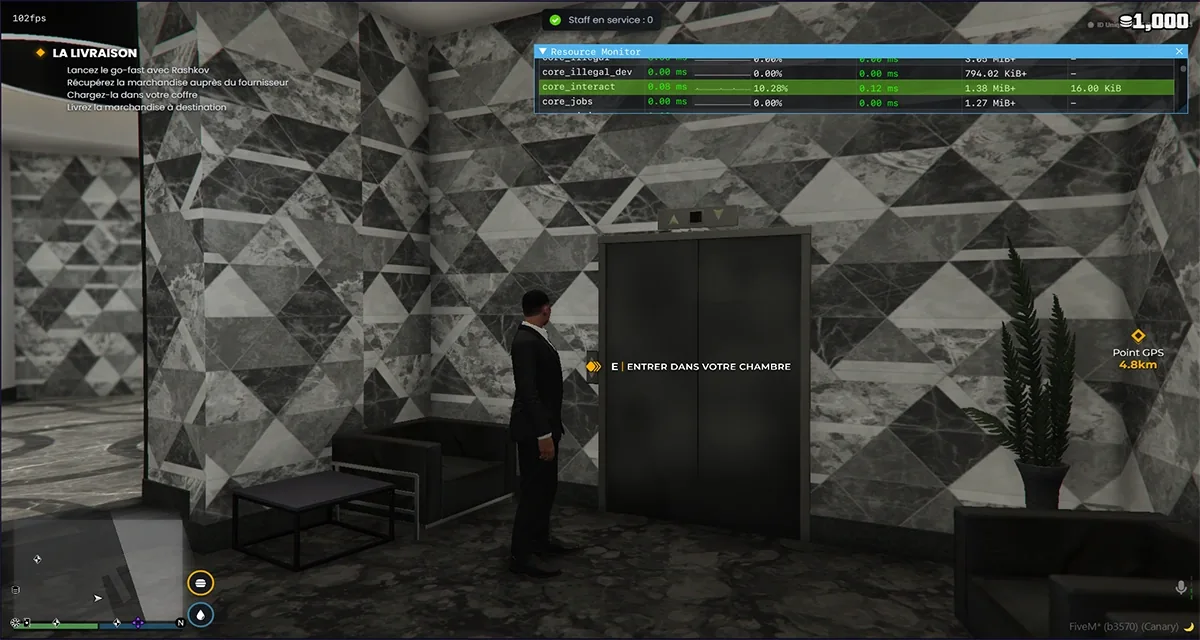
core_interact. An interaction point is displayed in 3D in the scene, and the reading shows 0.08 ms, the value measured on the bench. Captured 14 August 2026.A blind spot almost every guide shares: a script can be featherweight on the client and still flatten your database. Count the SQL queries per action as well. A resource that hits the database on every frame of an interaction will not show up in the client figure at all, and it is the one that hurts at sixty players. That is also why the open SQL schema, in check 3, is not a detail.
6. Is framework compatibility real or merely declared?
“Compatible with ESX and QBCore” means nothing on its own, because neither is one thing.
Four questions to ask:
- Which ESX? Legacy and 1.2 are not interchangeable.
- Which QBCore?
qb-coreand Qbox have diverged, and the answer is version-specific. - And vRP? The question looks secondary seen from Europe, and it is not. Brazil is the largest non-English-speaking FiveM market by player count, and most of its servers run vRP, not ESX or QBCore. A seller who has never been asked the question has not looked beyond their own market.
- Are the exports and events exposed in a file that is not encrypted?
The fourth is the real test. A vendor who exposes the bridge is telling you they expect you to adapt. A vendor who does not is asking you to adapt your server to their choices.
And the right follow-up is the fallback: what does the resource do when no known framework is present? Serious compatibility provides a standalone mode that depends on nothing, not just two branches for the two most common frameworks.
On the question people type right before clicking buy, whether a QBCore script runs on Qbox, the honest answer is: largely yes, not systematically. Dependencies and some exports differ. Anyone who answers a flat yes is selling, not advising.
7. What happens after the purchase?
Three post-purchase traps that no single page usually collects.
The entitlement error. Sooner or later you will meet You lack the required entitlement to use this resource, and it is very common. It means the server key in use was generated by a different Cfx.re account than the one that made the purchase. A server runs on one key, and you can check which one with sv_licenseKey in the console. The classic way in is haste: you buy with whichever account is at hand, not the one that generated the key. The good news is that it is recoverable: an ownership transfer from the Cfx.re Portal fixes it. But that transfer is normally possible only once, so it is worth not spending it by accident.
The refund. For digital content, the right of withdrawal is extinguished as soon as delivery begins with your consent, which for a script means the first download. Vendor policies observed in this market range from fourteen days no questions asked to strictly non-refundable. What matters is that the policy is written down and read before you pay.
The subscription. On a resource sold as a subscription, expiry removes the asset from your account and the script stops starting. Nothing breaks, nothing is deleted, it simply stops.
What we saw in the field
We did not write this page from a research desk. We wrote it because we made just about every mistake it describes.
Our team started by building its own server, among friends. None of us really knew how a FiveM server worked, let alone what could go wrong. We learned like everyone else, from setup tutorials found online.
We bought to buy time
The community grew faster than our ability to develop. Every week brought requests we did not have the hours to handle. Buying scripts was not a comfort, it was the only way to keep pace without making our players wait.
That is exactly the situation in which people check the least. It is also exactly the one in which they should check the most.
What we eventually understood
Three things, which came up so regularly that they ended up structuring this page.
Performance that had nothing to do with the advertising. Resources sold as the most optimised on the market cost us milliseconds we could not afford. The advertised figure was not false. It was measured in conditions that resembled nothing.
Scripts advertised as adaptable to any server, and impossible to adapt to ours. Often with no ill will from the seller: nothing had been surfaced in configuration. When we asked for a change, it was not planned, and we had no way to make it ourselves.
Resources published, then abandoned. Those do not break on the day you buy them. They break later, when FiveM moves on and nobody maintains anything on the other side. At that point you have not bought a script, you have rented a delay.
What that changed in how we build
Our scripts expose their configuration, their translations, their bridges and their SQL schema in the clear. That is not a commercial favour, it is the direct answer to what we went through: we did not want to sell what we had hated buying.
We are not writing this page to sell. We are writing it because nobody gave it to us.
The checklist in seven lines
- Does the checkout run through Tebex, with delivery to the Cfx.re Portal? It must.
- Does the seller have a dated release history on forum.cfx.re? It must exist.
- Is the price plausible for what is being sold? A thirty-script premium pack under twenty euros is not.
- What does the
escrow_ignorecontain? Config, locales, bridges, and the SQL schema. - Are there resmon readings in three states, with the protocol? Ask for all three and the test bed.
- Which exact framework versions, which fallback without a framework, and is the bridge readable? Version numbers, not names.
- Which Cfx.re account will own the asset, and what is the written refund policy? Before paying, not after.
Frequently asked questions
Can I be banned over a leak bought in good faith? The 2025 enforcement targeted servers confirmed to be running unauthorised assets. Intent is not a technical property of a file, which is why the check has to happen before the purchase rather than after the suspension.
Can I modify an escrow script? Only the parts the developer left outside encryption through escrow_ignore. Everything else is closed permanently. Ask what that directive contains before buying, not after.
Does a script at 0.00 ms exist? At rest, plenty. In use, no. A figure with no stated measurement state and no protocol tells you nothing.
How do I know whether a script contains a backdoor? On readable code, by looking for the three patterns described above. On an escrow resource it is impossible, and the question becomes the creator’s reputation. Know too that a backdoor breaks nothing: it extracts data, or it leaves a door open for a cheat.
Are free scripts compatible with every framework? No more than paid ones. The question is identical in both cases: which framework version, which fallback without a framework, and is the bridge readable.
Does Tebex refund? Tebex processes the payment, the seller sets the policy. It ranges from fourteen days to nothing at all, and the withdrawal right for digital content ends at first download.
Where do I find reliable free scripts? The real reference organisations, on GitHub: esx-framework, qbcore-framework, overextended for ox_lib and ox_inventory, and citizenfx. Starting anywhere else for a free resource is the most common way to pick up a backdoor.
Where these checks land on our own scripts
This page is only worth something if it can be used against us. So here is where each criterion is verifiable at Avenida, and what we do not yet meet.
What is open. Our escrow_ignore exposes the configuration, the translations, the bridges, the changelog and the SQL install schema. You can therefore read what the resource will create in your database before installing it, and adjust behaviour without asking our permission. Only the internal logic stays protected. A concrete case: the 368 tattoo zone corrections of the tattoo parlour sit in a config file you can keep correcting yourself.
Compatibility. Our scripts detect ESX, QBCore and vRP, and fall back to a standalone mode when no framework is present, relying on the game’s natives. A custom branch lets you wire in anything else, and the most widespread inventory, notification and interaction systems are preconfigured. The bridge files are readable, so the claim is verifiable rather than declarative: the barbershop page lists its seven bridges and states what each target costs you, vRP included.
Refunds. Our policy is written, and it is strict: no refunds as standard, with an exception if the script is non-functional and the problem is not resolved within seven business days. We own that rather than hide it. A digital product delivered, working and used for weeks is not returned, and the energy we do not spend arbitrating unfounded requests, we spend improving the scripts.
Performance. Every product page now carries its idle reading and the conditions it was taken under, which was the gap this article called out at publication. What is still missing is the loaded and stressed states in the same place: ask us for them on any resource, and hold us to that until they are on the pages.
See how these criteria check out across the catalogue.Change history
- 19 August 2026. Two claims in the last section were out of date and have been corrected: vRP is a detected target rather than a custom branch, and the idle reading is now published on every product page.
- 14 August 2026. Initial publication. Verified against the Cfx.re announcements of 8 August and 16 October 2025, and the Asset Escrow documentation.
Official sources
Every factual claim on this page comes from the documentation and official communications of Cfx.re, the publisher of FiveM. The performance readings are ours, with their protocol.
- Asset Security Update, Cfx.re forum: the enforcement announcements of 8 August and 16 October 2025.
- Asset Escrow documentation: encrypted formats and the
escrow_ignoredirective. - What’s a leaked asset then?: the reference discussion on the definition.
A question about a script before buying, from us or anyone else? The simplest route is to join our Discord. We answer about scripts we do not sell too.